




While AI coding platforms amass billion-dollar valuations, CFOs across the country have quietly been running their own AI experiments. The conventional wisdom is that developers adopted AI first, and every other knowledge-work function will soon follow. Indeed, a recent study from Anthropic shows that finance could be the next domino to fall.
As longtime investors in technology for the CFO suite (AuditBoard*, Avalara*, Coupa*, Intacct*, OutlookSoft and more), we wanted to test that thesis with real data. So we surveyed 129 CFOs and senior finance leaders at companies ranging from $50M to $5B+ in revenue. The survey was conducted from December 2025 through February 2026, and the respondent base is diversified across industries and company sizes. That said, 42% of respondents were from companies with 100–499 employees, and 54% have finance teams of five to 19 people. Here’s what we found.
We’re on the cusp of mass adoption—but real gaps remain
The AI-adoption pipeline tells an optimistic story on the surface: 17% of CFOs have AI in production, 34% are actively piloting it and another 28% are planning to. Only 21% are still just considering it.

But beneath that pipeline sits a striking failure rate. Among CFOs who have piloted AI, only four percent report a pilot success rate above 50%.
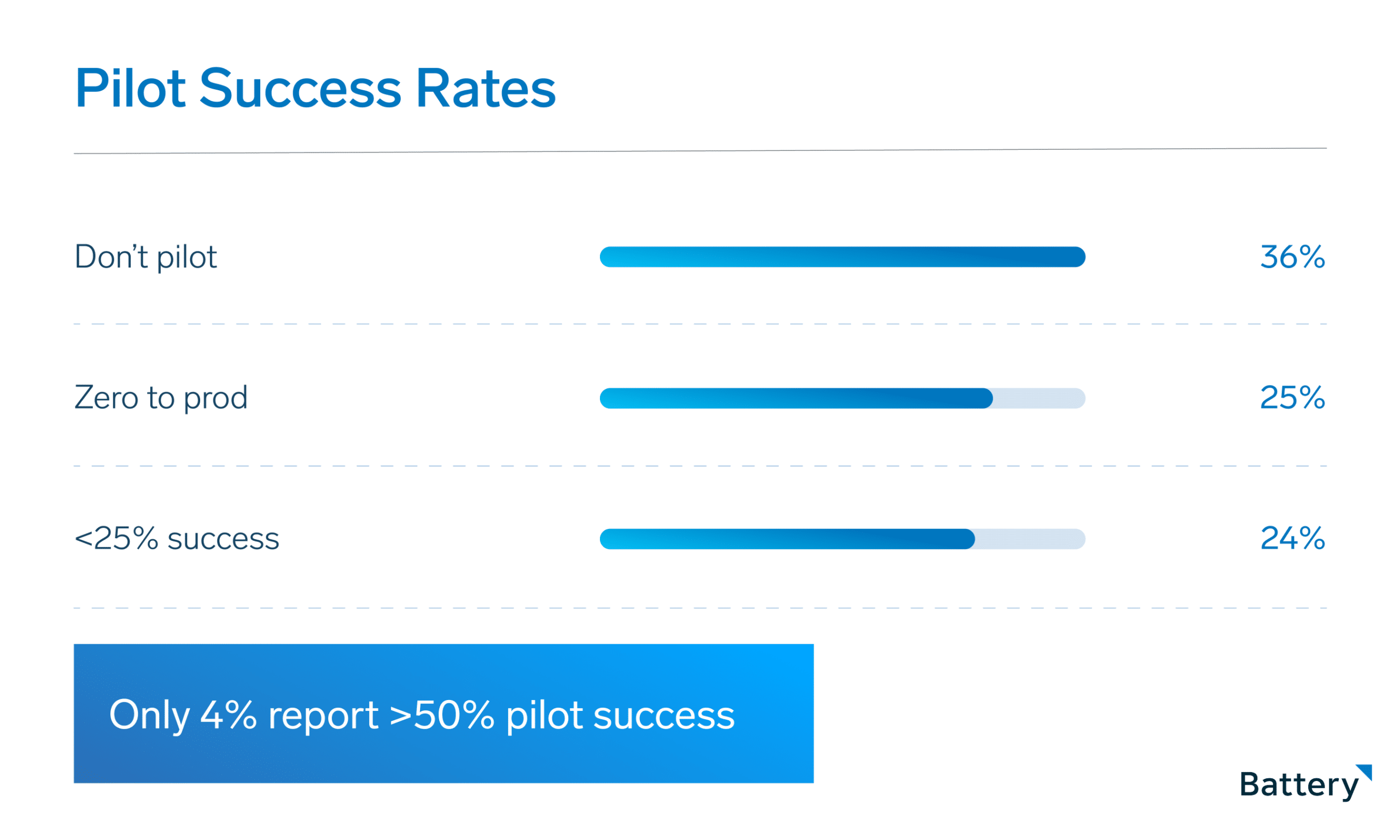
This is the central tension in the market: CFOs want AI, and they’re willing to spend on it, but the products generally aren’t delivering yet. Understanding why — and what’s about to change — is the key to reading this market correctly.
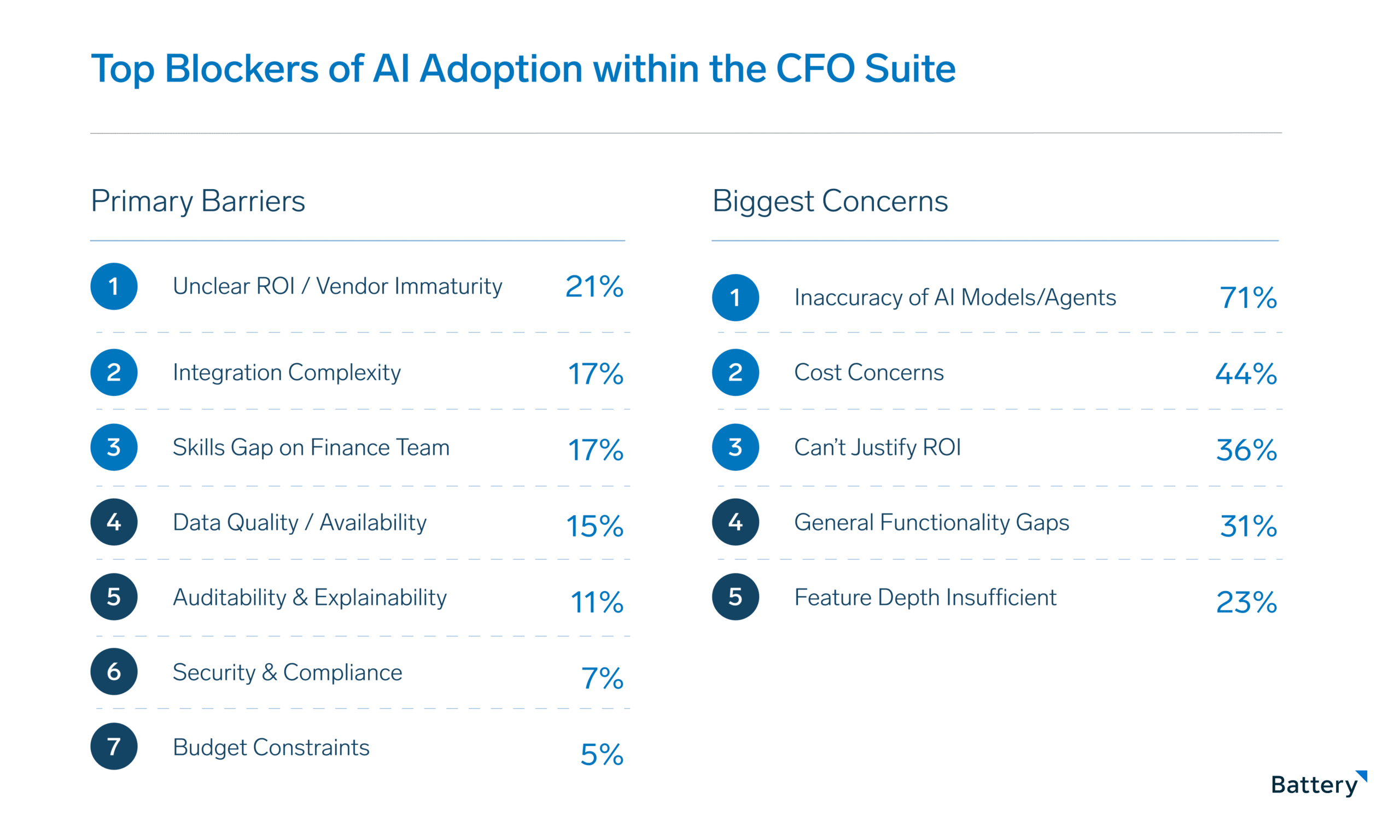
Barrier #2: Integration with existing platforms and data readiness. One of our core questions going into this survey was whether CFOs want AI capabilities from their existing systems of record or from AI-native vendors. The answer was decisive: 77% say they want to uplevel existing systems with AI from new vendors that layer onto existing systems, whereas only 15% want to replace their current system of record with an AI-native platform. The implication, however, is that data trapped in legacy systems must be cleaned, transformed, structured and unified to be model-ready. Yet 50% of respondents rate their data quality as only fair or poor.

 Why ROI may actually be right around the corner
We know the rate of improvement in foundation models continues to accelerate, which is why we believe the first challenge (i.e., lack of ROI driven by model limitations) has a near-term solution.
Consider one of the most compelling measures of AI progress: METR, an AI research organization, has been tracking the length of tasks that frontier AI agents can autonomously complete, measured by how long those tasks take human experts. The group’s finding is that this “task-completion time horizon” has been doubling approximately every seven months over the past six years. For context, the best current models can reliably handle tasks that take skilled humans a couple of hours; extrapolating the trend suggests AI agents could be handling day-long tasks within the next year or two.
AI is everything in our industry. We need to monetize it (we offer AI-first products), and we need to implement it operationally to drive efficiency and productivity internally, changing the long term financial profile of our business.”
CFO (500-1,000 FTE company)
Why does this matter for the CFO suite? The finance workflows that CFOs most want to automate—account reconciliations, invoice processing, variance analysis, journal entries—are exactly the kind of multi-step, structured-but-messy tasks for which this expanding time horizon is most relevant. As models get better at sustaining accuracy and context over longer, more-complex task chains, the gap between “impressive demo” and “production-grade automation” will narrow.
The second barrier Is where the application layer can capture value
If foundation models are solving for the first barrier, we believe AI applications are uniquely positioned to solve the second: data readiness and integration. Moreover, this is where we believe lasting value can be created and accrued.
One popular solution many companies are using to solve this problem is leveraging forward-deployed engineers (FDEs). For AI companies selling to CFOs, this model is especially relevant. Finance teams don’t operate in clean, standardized data environments. They run on a patchwork of ERPs, bank integrations, expense systems and Excel spreadsheets, all with different schemas, data-quality levels and integration points. In our view, the companies that will win here are the ones that invest heavily in enablement that can scale, like building data normalization into the product. Our survey data reinforces this: 16% of CFOs cite “too much setup/training required” as their biggest disappointment with current AI tools, and speed-to-value matters more to them than feature breadth.
The benefit that financial AI companies have is that they are dealing with motivated buyers under pressure. Fifty-seven percent of CFOs report moderate-to-strong pressure from their boards and investors to move on AI, and 72% expect their overall technology budgets to expand over the next two to three years.

Where finance organizations will actually adopt AI
Once these two problems are solved, how and where will finance organizations adopt AI?
Ninety-five percent plan to buy versus build, and 67% believe purpose-built finance AI tools are necessary for production workflows, as opposed to directly using foundation models.
Areas of priority include:
- Accounts payable (52% of respondents): companies like Ramp, Brex, Levelpath*, Zip, and Omnea
- FP&A and forecasting (40%): companies like Cube*, Summation, Pigment
- Accounts receivable (35%) – companies like Maxio*, Monk, Stuut, Lunos, Tabs, Fazeshift, Orb, and Metronome
- Close & consolidation (27%) – companies like Maximor, Numeric, Stacks, and Nominal
- Additionally, there are companies that are taking an all-in-one approach to the above like Campfire, Rillet, DualEntry, Light, Everest and Doss
In terms of budgets, 48% of respondents have carved out net-new AI spend, 22% plan to reallocate from existing tools and 18% have no AI budget today.
What this means for founders
This market is ready to buy but not yet convinced it should. The demand signals—board pressure, budget expansion, near-universal willingness to pay premiums—are unmistakable. The winners in this market will be the companies that:
Lead with proof, not promises. Positive POC results ranked highest in vendor evaluation criteria at 8.9 out of 10—well above any other factor. CFOs don’t trust accuracy claims on a slide; they trust demonstrated results from companies that look like theirs. The go-to-market playbook here is simple: Run tight, well-structured POCs, document them rigorously, and build a library of case studies segmented by industry and company size.
Solve the integration problem in the product. The 77% preference for layering onto existing systems means your product has to meet finance teams where their data actually lives. Importantly, your product must make your customer’s data usable without requiring systems change management.
Target production-grade accuracy. With 71% of CFOs citing model inaccuracy as their top concern, and the “killer capability” being invoice processing at 99%+ accuracy, the bar is not “pretty good.” Finance is a zero-tolerance domain. Build for 99%+ from day one, or your pilots will join the 96% that fail.

The window is wide open. Sixty-five percent of CFOs expect to start or expand AI use in the next one to two years, and 92% are willing to shift labor budget to AI tools. The companies that can turn that expectation into reality will define the next generation of technology for the financial suite.
The information contained in this market commentary is based solely on the opinions of Michael Brown, Aaron Neil, Alex Auchter, Matt Dailey, and Genki LeClair, and nothing should be construed as investment advice. This material is provided for informational purposes, and it is not, and may not be relied on in any manner as legal, tax or investment advice or as an offer to sell or a solicitation of an offer to buy an interest in any fund or investment vehicle managed by Battery Ventures or any other Battery entity. The views expressed here are solely those of the authors.
The information above may contain projections or other forward-looking statements regarding future events or expectations. Predictions, opinions and other information discussed in this publication are subject to change continually and without notice of any kind and may no longer be true after the date indicated. Battery Ventures assumes no duty to and does not undertake to update forward-looking statements.
* Denotes a Battery portfolio investment. For a full list of all Battery investments, click here.












A monthly newsletter to share new ideas, insights and introductions to help entrepreneurs grow their businesses.