




The loudest narrative around AI and the workforce is the one about job loss. The data from our latest enterprise technology spending survey tells a more grounded story.
When we asked 100 large enterprise technology leaders how their organizations are balancing AI investments with human hiring, 73% said AI is either purely augmenting existing teams without reducing headcount, or has had no measurable effect on hiring at all. Only 18% described any outright reduction—14% said AI is slowing hiring in some departments, and just 4% are in a full pause or freeze.
Augmentation, not displacement, is the headline we’re seeing.
Teams aren’t shrinking. They’re rotating.
The most common response, at 41%, was that AI is leading to a reallocation of hiring priorities: fewer traditional roles, more AI-focused ones. The profile of who gets hired is shifting even when total headcount does not. Engineers who can work alongside AI systems, analysts who can interpret model outputs, operators who can manage and evaluate agents—these roles are ascending. Entry-level roles focused on repetitive, rules-based work are shrinking.
The agentic layer reinforces the story
Looking ahead at agentic AI specifically, the picture stays consistent. Ninety-five percent of organizations expect agentic AI to have a meaningful impact on enterprise workflows over the next year—but almost none expect that impact to be mostly replacement. Forty-two percent of respondents expect agents to primarily augment existing human workflows. Fifty-three percent expect a balanced mix of augmentation and some automation. Only 1% expect agentic AI to primarily replace human workflows outright.
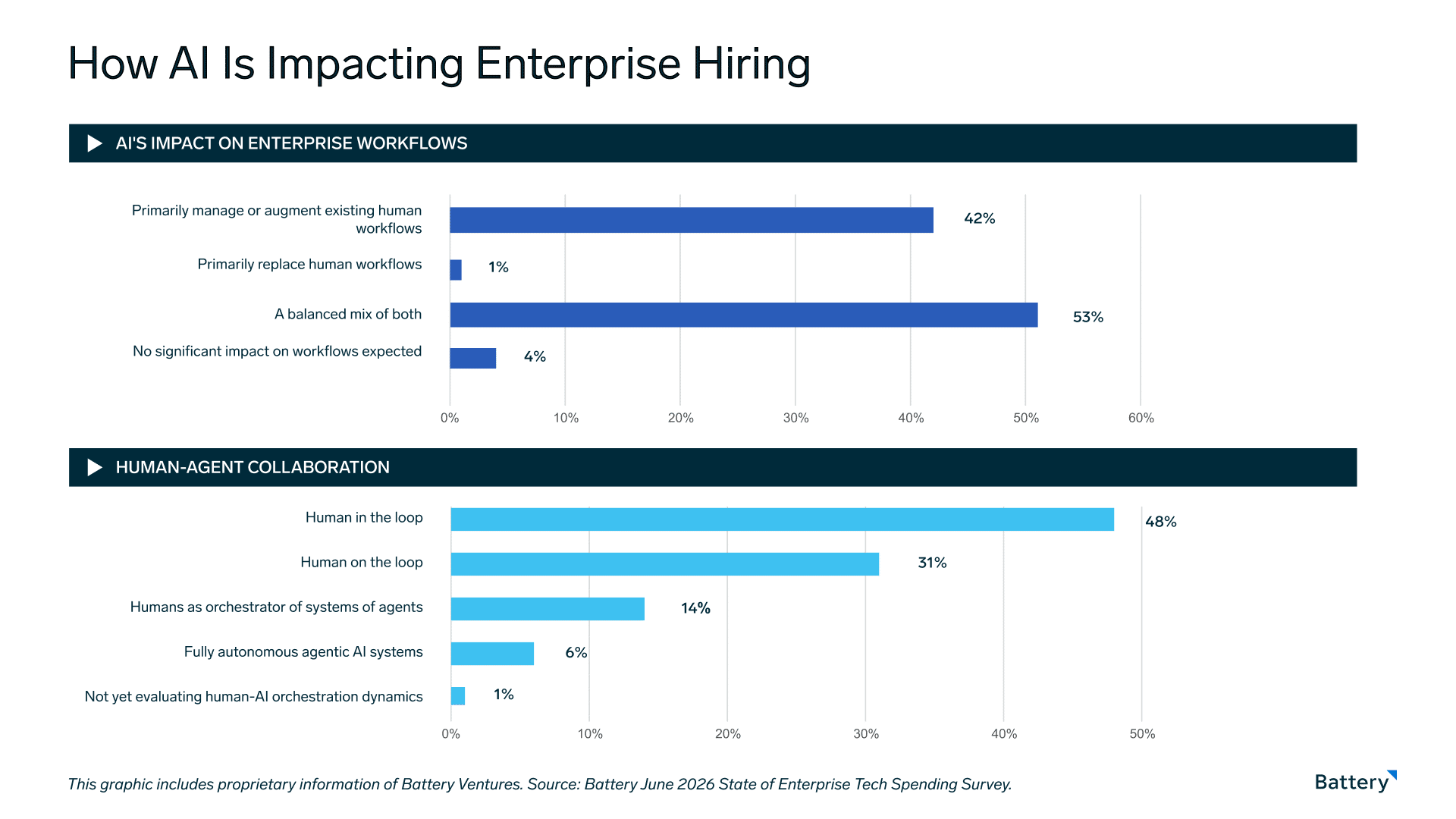
Even as organizations deploy autonomous agents to handle tasks humans previously executed, the dominant expectation is that humans remain central as orchestrators, reviewers, and decision-makers. The work changes, but the workforce largely stays.
Who’s steering the ship
Despite AI reshaping how people work, formal AI leadership remains concentrated in technology functions. Only 25% of enterprises have a Chief AI Officer in place today, with another 9% planning to appoint one within 12 months. The majority, 54%, have kept AI responsibility under existing tech leadership. Among those, the CIO edges out the CTO in outright ownership, 32% versus 29%.
What’s notable is how little of this governance has touched the people function within the enterprise. HR owns AI strategy at zero organizations surveyed, and a majority say HR has no involvement at all—despite AI being the most consequential force currently reshaping workforce planning.
That’s a structural gap. AI deployment decisions are being made in technology functions, but their workforce consequences are landing everywhere else.
The next challenge
The replacement narrative may be louder than the data warrants. The challenge enterprises are actually navigating is more durable: how to build and retain teams designed to work with AI, not just alongside it.
As organizations move from gen AI experimentation into agentic deployment, closing the gap between where AI decisions are made and where their workforce impact lands will matter more, not less.
This post is part of Battery’s 2026 Enterprise Spend Report series. Download the full report.
The information contained in this market commentary is based solely on the opinions of Nick Elsner, Scott Goering, and Evan Witte, and nothing should be construed as investment advice. This material is provided for informational purposes, and it is not, and may not be relied on in any manner as legal, tax or investment advice or as an offer to sell or a solicitation of an offer to buy an interest in any fund or investment vehicle managed by Battery Ventures or any other Battery entity. The views expressed here are solely those of the authors.
The information above may contain projections or other forward-looking statements regarding future events or expectations. Predictions, opinions and other information discussed in this publication are subject to change continually and without notice of any kind and may no longer be true after the date indicated. Battery Ventures assumes no duty to and does not undertake to update forward-looking statements.










A monthly newsletter to share new ideas, insights and introductions to help entrepreneurs grow their businesses.