




In 2025, AI-generated deepfakes and voice clones have fueled a surge in impersonation scams, making it increasingly difficult to distinguish real interactions from forgeries—and resulting in significant financial losses for companies and individuals. Cybercriminals armed with generative AI can now mimic trusted voices and even create convincing live video spoofs, bypassing traditional identity checks. The result is a spate of headline-grabbing breaches affecting organizations worldwide. For example, last year, it was reported that a financial employee at a large company in Hong Kong transferred $25 million to criminals after being duped by what appeared to be a live video call with other people from his company, who asked for the transfer.
A 2025 Gartner survey found that 43% of cybersecurity leaders had seen at least one deepfake audio incident, and 37% witnessed deepfake videos used in attacks. Even elite hacking groups are leveraging AI impersonation: A group called the Scattered Spider, for example, has infiltrated Fortune 500 companies by impersonating employees and IT support over the phone, tricking help desks into resetting passwords or MFA codes and then breaching accounts.
It’s against this backdrop that Battery Ventures is thrilled to announce our investment in imper.ai*, a company pioneering real-time impersonation detection across the modern workplace. Imper.ai was founded to secure what we see as the human layer of enterprise security: the live interactions over Zoom, Teams, Slack, phone, and email where people trust they know who’s on the other end. When that trust can be faked at scale, companies need new tools to fight back. Imper.ai’s platform acts like a watchdog for authenticity within these channels, detecting deepfake voices, manipulated videos, and other impersonation attempts as they happen, before an impostor can do damage. In short, imper.ai is building the real-time, identity-validation system that today’s social-engineering threat landscape demands.
Imper.ai’s Approach: Real-Time, Multi-Signal Impersonation Defense
Imper.ai approaches this problem in a fundamentally different way than content-only deepfake detectors. Rather than scrutinizing pixels or audio waveforms in isolation, imper correlates a web of signals, from device and network characteristics to behavioral cues and external data, to assess if a person is truly who they claim to be. This multi-factor, context-aware verification is much harder for attackers to fool. For example, if an employee’s voice on a call doesn’t match the subtle acoustic profile of their past calls, or the video feed’s metadata looks off, or the session originates from an unusual device or location, imper.ai’s engine will flag and block that user as a potential impostor in real time. By analyzing hundreds of technical and behavioral attributes behind the scenes, the platform can catch deepfake attempts that would slip past a naked eye or ear.
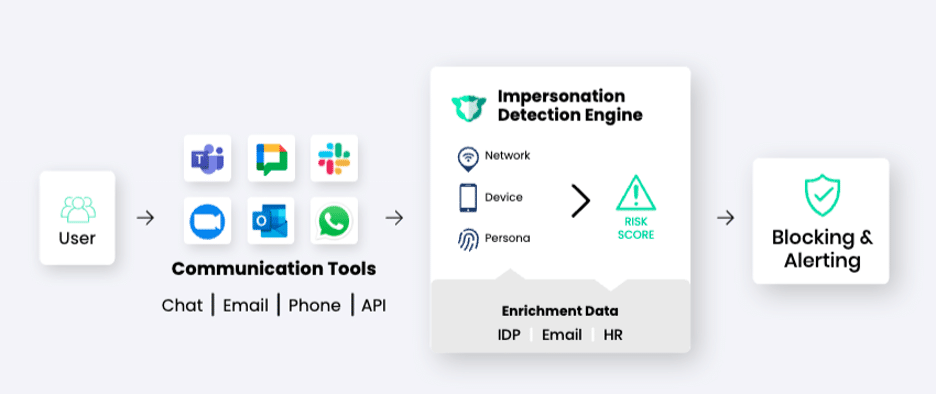
Equally important, imper.ai designed its solution to fit seamlessly into existing workflows. It’s an agentless, cloud-native deployment, meaning employees don’t have to install anything on their devices, and calls or meetings aren’t bogged down by new software. Imper hooks into communication platforms via APIs and monitors sessions.
The team has put a premium on privacy: The system performs ephemeral analysis with no data retention, checking authenticity without storing any sensitive audio or video recordings. And by leveraging organizations’ existing context (corporate directories, device telemetry, known user baselines) alongside open-source intelligence, imper.AI can validate identities without lengthy pre-enrollment steps. In practice, we have found deploying imper feels less like adding a new tool and more like upgrading your current collaboration and identity stack with a much-needed impostor alarm. Early customers have been able to activate imper across tools like Microsoft Teams and Zoom within hours via out-of-the-box integrations.
The Team Behind imper.ai
We believe great products stem from great teams, and in our view, imper.ai’s founding team—Noam Awadish, Rom Dudkiewicz, and Anatoly Blighovsky—bring an elite pedigree in cybersecurity and AI. The founders are veterans of Israel’s Unit 8200 (the well-known, military cyber-intelligence unit) and Mobileye (a pioneer in computer vision). They’ve worked together closely for years, marrying deep cybersecurity know-how with cutting-edge AI engineering and enterprise software experience. We feel this cross-domain expertise across threat detection, visual/audio AI, and real-world incident response gives the team a unique perspective on the impersonation problem. They understand both how attackers operate and how complex enterprise environments work, and we think that shows in imper’s design.
Why We’re Excited to Partner with imper.ai
At Battery, we have a core thesis that security, fraud prevention, and identity must be reimagined for an AI-native world. Imper.ai squarely aligns with this belief. Just as we’ve invested in companies tackling the new risks of AI in domains like cloud and endpoint security, imper is addressing perhaps the most personal and pernicious risk of all: the risk of being fooled by a fake human. Business trust is built on knowing who you’re dealing with. We feel imper.ai’s technology restores that trust by ensuring that “Jane from IT” on the phone is truly Jane, and that your CEO on Zoom isn’t a synthetic impostor. By securing this human layer of business, organizations can confidently embrace AI-powered communication and collaboration tools without fearing that every call or email could be a trap. We’re excited to support imper.ai as it defines a new category of real-time identity threat detection.
The information contained in this market commentary is based solely on the opinions of Barak Schoster and Lior Mallul, and nothing should be construed as investment advice. This material is provided for informational purposes, and it is not, and may not be relied on in any manner as legal, tax or investment advice or as an offer to sell or a solicitation of an offer to buy an interest in any fund or investment vehicle managed by Battery Ventures or any other Battery entity. The views expressed here are solely those of the authors.
The information above may contain projections or other forward-looking statements regarding future events or expectations. Predictions, opinions and other information discussed in this publication are subject to change continually and without notice of any kind and may no longer be true after the date indicated. Battery Ventures assumes no duty to and does not undertake to update forward-looking statements.
* Denotes a Battery portfolio investment. For a full list of all Battery investments, click here.









A monthly newsletter to share new ideas, insights and introductions to help entrepreneurs grow their businesses.